
Meta's Andromeda Update:
The 5 Shifts Every DTC Brand
Needs to Understand
Meta just rewired how ads get delivered — and most brands are still running campaigns like it's 2023. Here's what actually changed, and how to adapt.
Watch the Full Breakdown
If you prefer video first, start here — then use the written breakdown below as your reference guide.
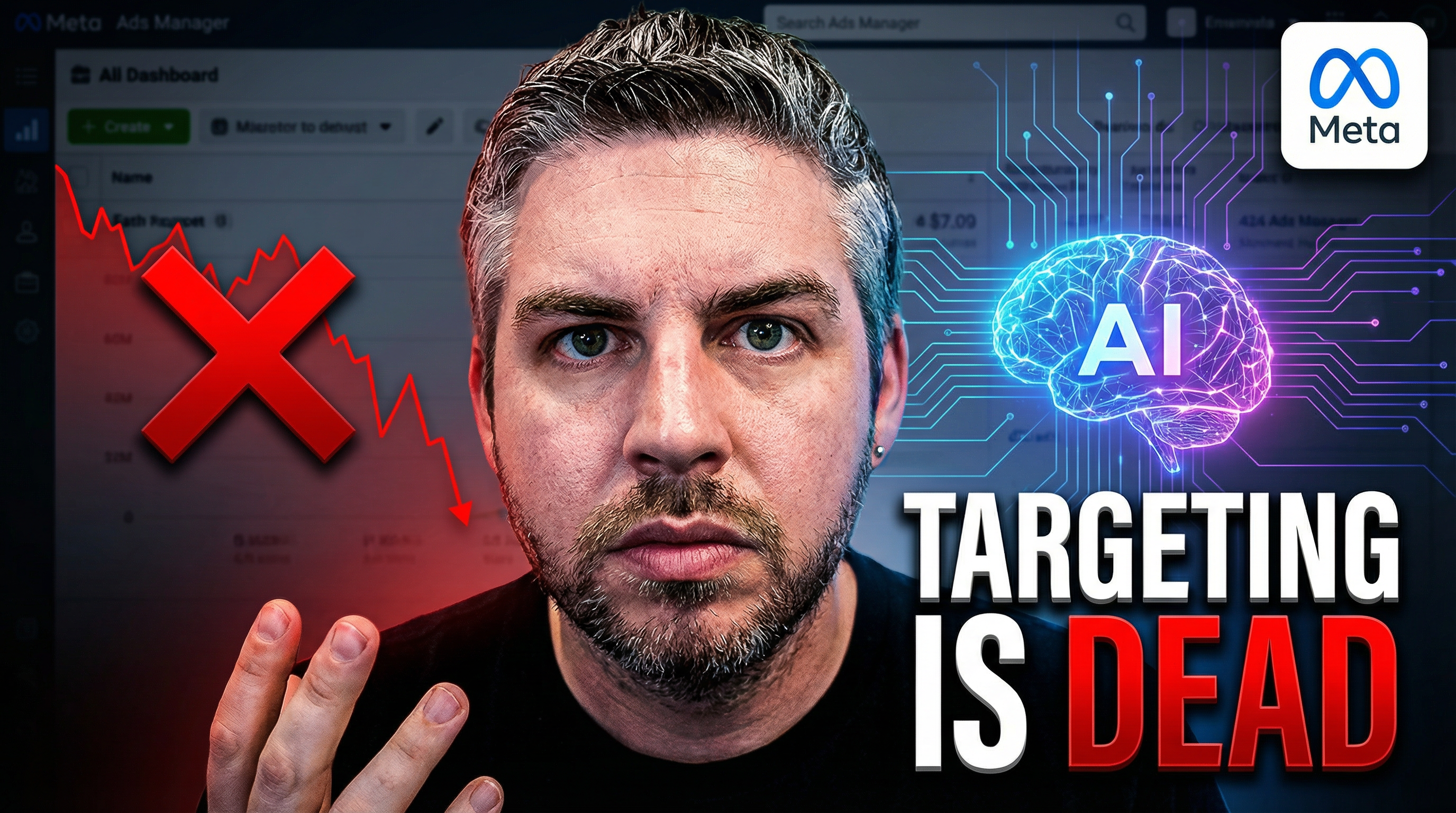
Why This Actually Matters
Most brands noticed something shift in their Meta performance — testing behaving differently, ROAS swinging unpredictably, campaign structures that used to work now underperforming. This isn't creative fatigue or a bad month.
In the last two months of 2025, Meta rolled out a major evolution to their Andromeda system — the AI that decides which ads get shown to which people. It completely rewired how the platform works at a fundamental level.
The brands that adapt to Andromeda are going to dominate 2026. The ones that don't will keep burning cash wondering why their ads stopped working.

"Still running 8 interest stacks in 2026. This is fine." 🐶🔥
About Aaron Hammond

Co-Founder at Three Beacon Marketing. Over the last decade, Aaron and his co-founder have worked with dozens of DTC brands in health, wellness, and lifestyle — helping them grow profitably through paid media and retention systems.
Your Roadmap for This Guide
Here's everything we cover — from the technical background on Andromeda to the five practical shifts you need to make right now.
What Andromeda Actually Is
Andromeda is Meta's retrieval engine — the first stage of ad delivery where the system takes millions of possible ads and narrows them down to a few thousand candidates that might get shown to someone.
The old system worked like a king-of-the-hill contest. You'd give Meta a few ads, it would quickly find the strongest performer, and then pour almost your entire budget into that single winner. That's not how it works anymore.
The explosion of Advantage+ automation and generative AI tools meant millions more ads were flooding the system daily. The old infrastructure couldn't handle it. So Meta built Andromeda to process a 10,000x increase in model complexity while handling hundreds of times more ads than before.
Hundreds of times more ads to process.
The new system is a matchmaker. It takes your entire portfolio of ads and actively seeks out specific pockets of your audience that will resonate with each unique message. The technical specs don't matter to you as an advertiser — what matters is this: Meta's AI now has the capacity to deliver truly personalized ads at scale, but only if you give it what it needs.
And what it needs is creative diversity — which brings us to the five shifts.
Creative Diversity Replaced
Audience Targeting
Meta said it explicitly in their April 2025 update: "With the rise of AI-enabled advertising tools, the focus has shifted from niche targeting to creative diversification as the best lever to find the most relevant audiences."
Translation: your competitive advantage is no longer in how precisely you target people. It's in how diverse and compelling your creative portfolio is.
The old playbook was narrow audience targeting with a few polished ads. Stack interests, layer demographics, split-test audiences against each other. That playbook is dead.
The new playbook is broad targeting with a diverse creative portfolio that speaks to different people, different problems, and different contexts.
Andromeda is designed to match specific ads to specific people. If you only give it one angle — say, a single product demo video — it can only try that one approach with everyone. Give it a portfolio that leans into different pain points, personas, and awareness levels, and the system learns who responds to each message.
This isn't about making 15 versions of the same ad with slightly different hooks. That's creative duplication — not diversity.
"Creative variation" vs "creative diversity" — spot the difference 👀
Real creative diversity: a fitness brand example
Same brand. Same offer. Completely different creative strategy — and dramatically better results, because you're finally giving Meta's AI the raw material it needs to personalize at scale.
Campaign Structure Simplifies Dramatically
If creative diversity is doing the heavy lifting, what does that mean for campaign construction? It gets way simpler.
- One campaign per conversion goal. Purchases, leads, and add-to-carts each need their own campaign. But beyond that? You probably don't need more.
- One ad set per campaign in most cases. Broad targeting. Advantage+ audiences. Let the creative do the targeting work.
- 8–15 truly diverse ad concepts in that ad set. This is where you invest your time — different concepts, formats, personas, awareness levels.
- Stop splitting budgets across 5+ ad sets to "test" audiences. That era is over.

Compare that to the old structure where brands would have 5 campaigns, each with 3–6 ad sets testing different audience stacks, with 2–3 ads per ad set. That's 30 to 90 moving pieces you're trying to manage.
Now? One campaign. One ad set. Twelve ads. Twelve moving pieces. The system is simpler. Your decisions are clearer. And your time shifts from campaign architecture to creative strategy.
Here's the principle: complexity should exist where it creates leverage. Campaign structure doesn't create leverage anymore. Creative diversity does. So simplify the structure. Deepen the creative.
If you've spent years mastering complex campaign architecture, this feels like throwing away expertise. It's not. The platform changed. The old expertise is a liability now. The new expertise is understanding how to build creative portfolios that give Andromeda what it needs to work.
Targeting Happens In the Ad Now
Under the old system, you targeted people through campaign settings — demographics, interests, behaviors, custom audiences. The ad was just the message you delivered once you found the right person.
Under Andromeda, it's flipped. The ad is the targeting mechanism.
When you create an ad that speaks specifically to a new mom struggling with postpartum weight and feeling like she's lost her identity, you're targeting new moms — not through an audience setting, but through the message itself. The people who resonate with that ad are the people it's designed for. Everyone else scrolls past. The system learns from who engages and optimizes delivery to more people like them.
Your ad creates one.
Stop chasing the perfect audience combo. There isn't one. The "winner" for one person will flop for another. That's the point. You're not trying to find one perfect audience — you're trying to reach multiple audiences with multiple messages, and you're letting Andromeda handle the matching.
Keep your ad sets broad. Advantage+ audiences. Open targeting. Maybe exclude past purchasers if you're doing acquisition — but that's about it. The tighter you make the audience, the less room Andromeda has to find the people who will respond to each specific ad.
We use a framework called P.D.A. — Persona, Desire, Awareness — to make sure every ad we create is genuinely targeting a different micro-audience.
Every combination of those three variables creates a different ad concept. And each one targets a different slice of your market. That's how you do targeting now — not in the campaign settings. In the creative itself.
Andromeda reading your creative to find its perfect audience 🎯
You Need More Ads — But They Must Be Strategically Different
For years, Meta's guidance was: don't put more than 6 ads in an ad set. They said there was no clear benefit beyond that.
In February 2025, that recommendation disappeared. And while Meta never explicitly said why, it's obvious — Andromeda changed the math. We're now seeing success with 8–15 ads per campaign. Some advertisers are running 50. The system can handle it because it's not trying to find one winner anymore — it's trying to match the right ad to the right person.
But here's the critical thing: more ads only works if they're strategically different. If you create 15 ads that are all the same concept with minor tweaks — different colored backgrounds, slightly different hooks, same core message — you're wasting the system's capacity.
😬 "Here's 15 versions of our hero ad."

🎯 "Here's 12 P.D.A.-mapped concepts across 4 formats."
Think of it like a restaurant menu. If you have 15 items but they're all variations of chicken parmesan — one with extra cheese, one with less sauce, one with different pasta — you don't have a diverse menu. You have one dish with 15 tweaks. Andromeda wants chicken, fish, steak, vegetarian, and vegan options.
How to build a diverse portfolio without burning out your creative team:
- Mix formats. You don't need to shoot 15 videos. 3 core video concepts + static image ads + carousel ads + text-on-background quote ads. Format diversity counts.
- Use P.D.A. Map out 3 personas × 3 desires × 3 awareness levels = 27 possible combinations. Strategically pick 8–12 that fit your brand and market.
- Batch production. Don't create 15 ads one at a time. Batch shoot video, batch write static concepts, batch design. Treat creative production like a system, not a one-off project.
- Judge portfolio health, not single-ad ROAS. Some ads will get tons of spend. Some will get very little. That's not a bug — Andromeda is holding low-spend ads in reserve for specific micro-audiences it hasn't activated yet. Don't kill them early.
The rule we use: turn off clear losers that get decent impressions but terrible CTR. But don't kill low-spend ads just because they're low-spend. Let the system work. The goal isn't to find the one perfect ad — it's to build a portfolio that covers enough ground for Andromeda to personalize effectively.
Your Competitive Advantage is Creative Production Capacity
If creative diversity is the new lever for growth, then your competitive advantage as a brand is no longer in your media buying sophistication.
That's a different skill set than most DTC brands have built. Most brands treat creative like a bottleneck — produce a few assets every quarter, test them, then run the winners into the ground until performance degrades. That doesn't work anymore.
You need to treat creative like a system: a repeatable process for generating diverse concepts, producing them efficiently, and refreshing your portfolio regularly.
This is why we've embedded a designer and video editor directly into our team structure. It's not outsourced. It's not a one-off project. It's a core competency — because if you can't feed Andromeda what it needs, you're fighting the platform. And if you're fighting the platform, you're going to lose to competitors who aren't.
Your competitors can copy your targeting strategy in five minutes. They can't replicate your creative production capacity overnight. This is where the real competitive moat is now.
IS your media buying advantage.
The Full Picture

Brands who adapted to Andromeda, watching their ROAS climb 📈
Where to Find Me
Email: [email protected]
Follow me on my socials for more helpful tips and guides. If you're a DTC brand spending on Meta and you want to scale without guessing, you'll feel at home.
Want Us to Audit
Your Setup?
We'll audit your campaigns, pinpoint what's blocking growth, and give you a clear gap analysis to adapt.
Whether you run with it yourself or partner with us — you'll walk away with clarity.