
The Hidden Cost of
"Trying Everything" in Marketing
Most brands don't fail because they're not doing enough. They fail because they're doing too much — with no system. And that keeps them stuck in a loop of motion without growth.
Watch the Full Breakdown
Prefer to watch first? Start here. The written guide below expands every concept with visuals and frameworks you can use immediately.
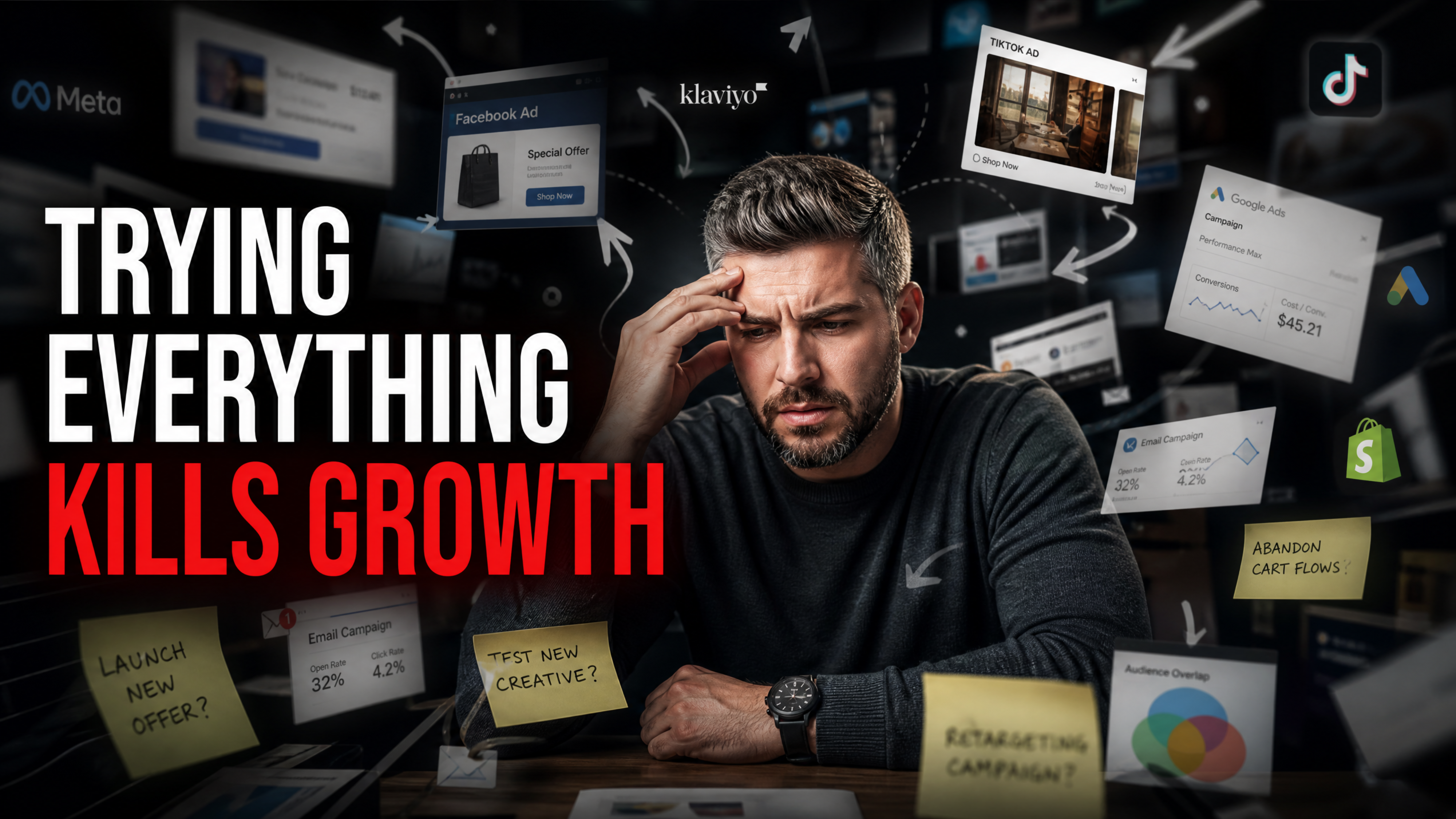
Most Brands Don't Have a Marketing Problem
They have a focus problem. Testing new creatives. Trying different hooks. Launching new offers. Thinking about TikTok. Talking about influencers. Considering affiliates. Reworking email. Maybe Reddit. Maybe YouTube. Maybe podcast sponsorships.
On paper, it looks like you're doing everything right. You're active. You're moving. But then you look at the actual business — and nothing really moves. Revenue bumps. Then stalls. Then everyone gets nervous. Then you try something else. The cycle starts over.
But the business does not feel stronger.
"Trying everything" feels responsible. It feels aggressive. It feels like you're doing the work. But in most businesses, it's one of the fastest ways to destroy signal, confuse your team, waste budget, and stay stuck.
About Aaron Hammond

Co-Founder at Three Beacon Marketing. We work with DTC ecommerce brands trying to grow in a way that's actually repeatable. This is one of the most common patterns we see when brands are stuck — they're not under-active, they're over-active. Changing too much, too often, without a clean way to understand what actually worked.
Your Roadmap for This Guide
Five concepts that explain why "trying everything" destroys performance — and exactly what to do instead.
Motion Is Not Momentum
Here's how it always starts. Sales are a little soft. CAC is creeping up. Someone on the team sees a trend. Someone says "we should test that." And that sentence is where most problems begin.
"We should test that" sounds smart. It sounds low risk. It sounds proactive. But without a system behind it, it becomes a trap. One test becomes five. Five becomes twelve. Now every week the business is running in six different directions.
You're not building a strategy. You're building a junk drawer. And the worst part is, it feels good — because trying everything gives you the illusion of control. But activity is not progress. Motion is not momentum. Effort is not strategy.
Learning requires clarity.
Here's how this plays out in practice. A brand says they're testing a new offer. But at the same time they change the landing page, launch new creative, adjust the audience, increase the budget, send three emails, and run a sale. At the end of the week they ask: "Did the offer work?"
You changed seven things. You don't know what worked. You spent money, burned team capacity, and at the end you're still guessing. That is not growth. That is expensive confusion.
Testing vs. Guessing
Most brands say they are testing. They are not. They are guessing with better branding. Calling something a "test" does not make it a test.
"Let's test new creative." "What are we testing?" "The creative."
This is why single-variable testing matters. Not to make marketing more complicated — the opposite. It makes it cleaner.
Test message first: what pain or promise gets attention? Then creative: which format delivers it best? Then landing page, then offer, then scale. Each layer builds on the one before. That's how testing becomes an asset instead of chaos.
Testing creates reusable knowledge. Guessing creates temporary luck. And luck is not a growth strategy.
How "Trying Everything" Destroys Signal
Every marketing system needs signal. Signal tells you what's working, what customers care about, what's worth scaling, what to stop doing. But signal is fragile.
Stack too many changes and you bury the signal. It's like trying to hear one person talking in a room where everyone is yelling. Maybe something useful is being said. Good luck finding it.
The team launches five creative angles, changes the landing page, tests a discount, adds a bundle, adjusts budgets, sends more email, changes campaign structure. Performance shifts. Everyone sits in the meeting trying to reverse-engineer what happened.
Good testing creates decisions.
The danger is not just wasted time. The danger is that the loudest voice starts winning. The founder says it was the offer. The media buyer says it was the creative. The retention person says email drove it. Everyone has a theory. Nobody has proof. Decisions are made based on confidence or whoever talks last.
The goal of testing is not to test for the sake of testing. The goal is to make the business smarter. Every test should answer a question that helps you make better decisions later. If it doesn't — it's probably just noise. And most brands are drowning in it.
The 4 Hidden Costs
The obvious cost of random testing is wasted ad spend. But the real costs are bigger — and most brands never even account for them.
Most marketing teams right now. Running hard. Going everywhere. Arriving nowhere. 🏁
Scaling requires repeatable wins. Not vibes. Not "that worked one time." Not "we had a good week." Repeatable wins — meaning you know what worked, why it worked, and how to apply that learning again. Random testing never gets you there.
What Actually Works
Brands that scale don't try everything. They build systems that let them learn faster with less chaos. Here's what that looks like.
Before launching anything, ask: "What are we trying to learn?" — not "what are we trying to launch?" If the goal is just to launch, anything counts. If the goal is to learn, the test has to be structured around a real question. "Are customers more motivated by saving time or improving performance?" That's a real question. Build around it.
Start with message — what pain, desire, or promise gets attention? Then creative — what format delivers that message best? Then landing page — does the post-click experience support the message? Then offer, then scale. Each layer builds on the one before. You're not just collecting results. You're building a map.
A company without documentation is a company with amnesia. And companies with amnesia keep paying for the same lessons. Document what you tested, why, what the hypothesis was, what changed, what didn't, what happened, what you learned, what decision you made. That's how the business gets smarter instead of starting over.
Platform learning lags. Customer behavior lags. Attribution lags. If you judge everything in 48 hours, you're not being decisive — you're being impatient. Make decisions off data, not noise. Obvious losers get cut fast. But most tests need enough impressions, conversions, and time for the system to settle before you can read them accurately.
Most brands spend 80% of their energy exploring and 20% exploiting what works. It should usually be the opposite. If an angle works, build around it — more ads, a landing page, email, UGC prompts, founder video, different awareness levels, different products. The market told you something matters. Listen. That's not lazy. That's leverage.
This is what focus actually looks like inside a business that's scaling. Not frantic. Not scattered. Locked in on what's working — and building around it methodically.
Focus is not just choosing what to do. Focus is choosing what to ignore. And most brands are terrible at that — because ignoring things feels like falling behind. It's usually the opposite.
The Full Picture
expensive cardio.
If your marketing feels busy but not predictable — you're probably not lacking ideas. You're lacking a system. Turning random testing into structured, repeatable growth is fixable. But it starts with slowing down enough to understand what's actually working.
Where to Find Me
Email: aaron@threebeaconmarketing.com
Follow me on my socials for more. If you're a DTC brand trying to build marketing that actually compounds instead of resetting every month — you'll feel at home.
Want Help Building a
Real Testing System?
We'll break down your current strategy and show you how to turn random testing into structured, repeatable growth — so your team stops resetting and starts compounding.
Whether you run with it yourself or partner with us to execute, you'll walk away with clarity.