
Why Your Marketing Feels Hard
(And the Real Reason It's Not Working)
Most brands think they have a marketing problem. Bad ads. Weak creatives. Poor targeting. But in reality, the issue is deeper. It's misalignment — and no amount of ad testing fixes it.
Watch the Full Breakdown
Prefer to watch first? Start here. The written guide below expands every concept with visuals and frameworks you can use immediately.
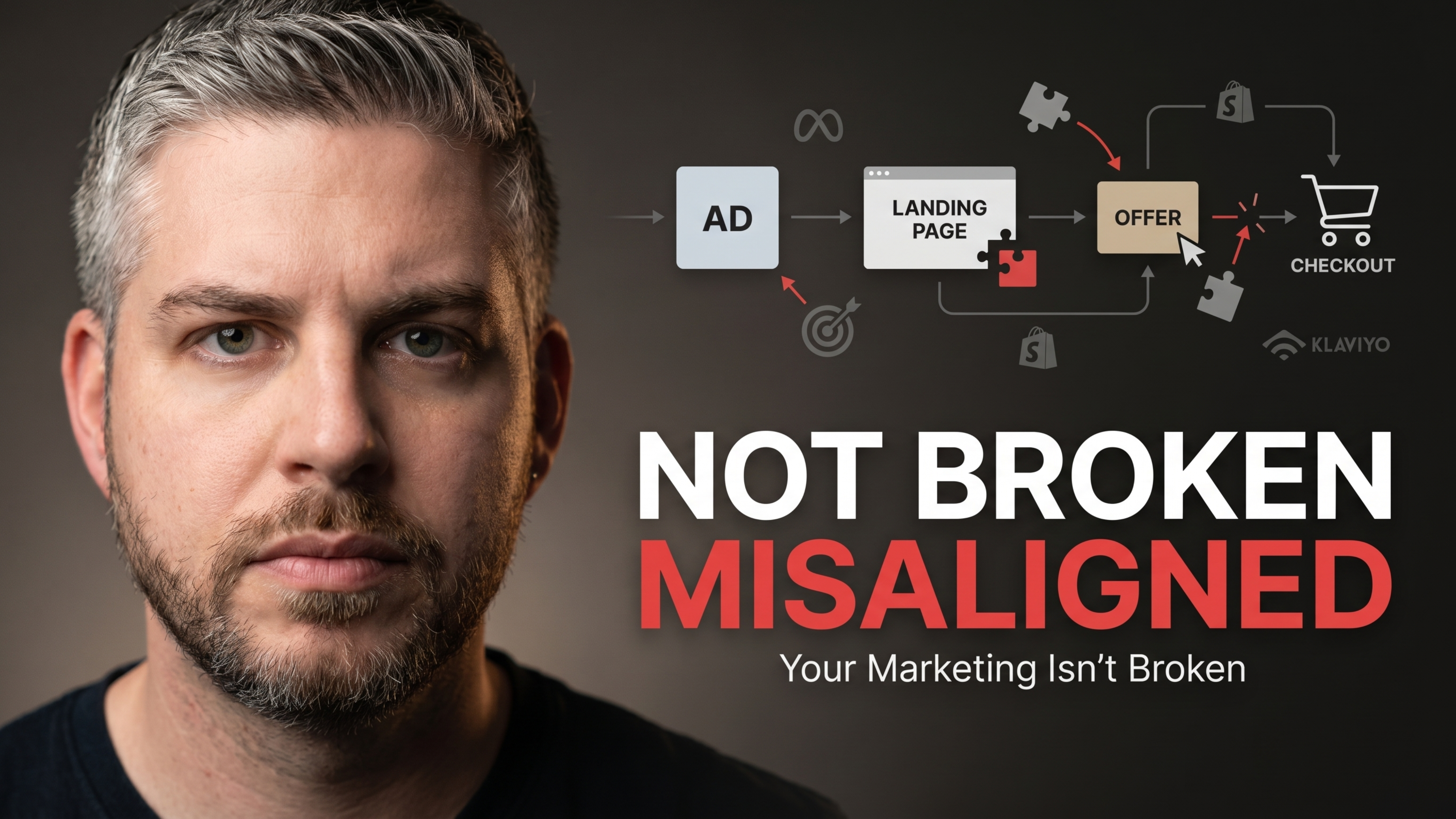
Your Marketing Isn't Broken — It's Misaligned
Most brands think their marketing isn't working because their ads suck. So they do what everyone does. Change creatives. Test new hooks. Rebuild campaigns. Try a new landing page. Change the CTA. Maybe blame Meta for a little while.
And sometimes performance improves a little. Just enough to make everyone think they fixed it. Then two weeks later, it stalls again. CAC creeps back up. The "winning" creative stops winning. So the team goes back into the same loop.
everything feels like dragging a couch up a staircase.
The real issue usually isn't that the marketing is broken. The real issue is that the marketing is misaligned. And when you fix alignment, a lot of things you thought were "ad problems" suddenly get easier — not because of some genius growth hack, but because of basic marketing physics.
About Aaron Hammond

Co-Founder at Three Beacon Marketing. We work with DTC ecommerce brands trying to grow without turning marketing into a pile of random tactics. This is one of the biggest root problems we fix — not bad ads, not bad media buying, not bad creative alone. Bad alignment. Because you can have talented people working really hard and still get mediocre results if the pieces don't line up.
Your Roadmap for This Guide
Five concepts that explain what misalignment is, how to spot it, the four layers that must line up, and exactly what to fix first.
What Misalignment Actually Is
Alignment means the customer, message, offer, and experience all make sense together. The person you're speaking to is clear. The message speaks to what they actually care about. The offer matches their level of trust and intent. And the buying experience after the click reinforces the promise instead of confusing them.
Misalignment is when one or more of those pieces break. And the annoying thing is — you can still have decent performance with misalignment. That's why it hides. You can still get clicks, some purchases, a campaign that looks okay in-platform. But it won't scale cleanly, won't feel predictable, won't compound.
Here's an example. You're selling a premium skincare product. The ad talks about "clean ingredients." People click. But then they land on a page full of product specs — ingredient list, texture, size, how to use. No emotional reason. No problem being solved. No positioning.
The customer is thinking: "Why this? Why now? Why should I trust you? Why is this worth $78?" That's misalignment. The ad created curiosity. The page failed to close the belief gap.
Your customer does not experience your marketing in pieces. They experience it as a sequence. If that sequence feels disconnected, they leave. Then you call it a CAC problem. It's not. It's an alignment problem.
How Misalignment Shows Up
Misalignment is not abstract. It shows up very clearly in performance data — if you know what you're looking at.
Misaligned marketing at scale. Everything technically still running. Nothing holding together. 🧩
The algorithm is not perfect, but it gets blamed for bad strategy more than it deserves. If your message only works for a narrow slice of the market, more budget doesn't fix it. Better alignment does.
The 4 Layers That Must Align
There are four layers that need to line up. When they do, everything gets easier. When any one breaks, friction builds at every step downstream.
Why This Makes Marketing Feel Hard
When alignment is off, everything takes more effort. Ads need to work harder because the message isn't sharp. Landing pages need more traffic because conversion is weak. Email needs more discounts because trust wasn't built properly. Paid media needs more budget because the offer isn't doing enough work.
Instead of momentum building, momentum keeps resetting. That's exhausting — for the customer and the business.
This is why good marketing does not feel like a fight. When things are aligned, the work starts to compound. You don't need to reinvent everything every week. You understand the customer, you know what message matters, you know what offer fits. That gives you direction. And direction is what most brands are missing. Not effort — direction.
When enough misalignment resistance builds up, everything looks like a performance issue. "The ad doesn't work." "The page doesn't convert." "The offer isn't strong." "The channel is getting expensive." But the real issue is that the parts are not working together.
What to Fix First
If your marketing feels misaligned, do not start by changing everything. That's how you create another mess. Fix in sequence — because if the customer is wrong, the message doesn't matter. If the message is wrong, the offer feels weak. If the offer is wrong, the page has to work too hard.
Not everyone who could buy. Who are you trying to win first? Who is the customer with the strongest pain, highest intent, best fit, and highest long-term value? Define this too broadly and everything else gets mushy. The more specifically you can answer this, the sharper every downstream decision becomes.
What do they need to believe before they buy? This is a better question than "what should the ad say?" What belief is missing? Do they need to believe the problem matters? That your solution is different? That it will work for someone like them? Messaging is belief-building — not wordplay.
Is the ask appropriate for where they are? If they don't know you, maybe the right offer isn't your biggest bundle. Maybe it's a starter product, a quiz, a comparison page, a strong guarantee, or a bundle that reduces decision-making. The offer should reduce friction — not create more of it.
Does the page match the ad? Does it answer the objections? Does checkout feel easy? Does the upsell make sense? Does the follow-up continue the journey? Work through the customer sequence end-to-end — not as a marketer, but as a first-time customer who just clicked an ad for the first time.
Changing an ad is easy. Changing how you think about the customer is harder. But that's where the money is. The brands that mature stop treating marketing as a collection of tactics and start treating it as one connected customer journey.
The Full Picture
They're alignment problems.
When alignment finally clicks. Growth gets easier — not because the ads got better, but because the whole system makes sense. 💡
If your marketing feels harder than it should — don't start in the ad account. Start with alignment. Who are you really targeting? What do they actually care about? What are you asking them to do? Does the experience after the click make sense? If those answers are unclear, everything else will feel broken.
Where to Find Me
Email: aaron@threebeaconmarketing.com
Follow me on my socials for more. If you're a DTC brand trying to build marketing that actually compounds — not one that requires reinventing everything every month — you'll feel at home.
Want Us to Audit
Your Positioning?
We'll break down your messaging, offer, and funnel to identify where misalignment is killing performance — and what to fix first to unlock momentum.
Whether you run with it yourself or partner with us to execute, you'll walk away with clarity.